What is a ‘reasonable’ adjustment in high-stakes assessment?
How assessment providers are approaching reasonable adjustments, balancing fairness, legal duties and operational realities while protecting the integrity of professional assessments.
Reasonable adjustments are often talked about in broad, reassuring terms. In the assessment world, every decision has to balance access, fairness, operational constraints and the standards the assessment is there to test.
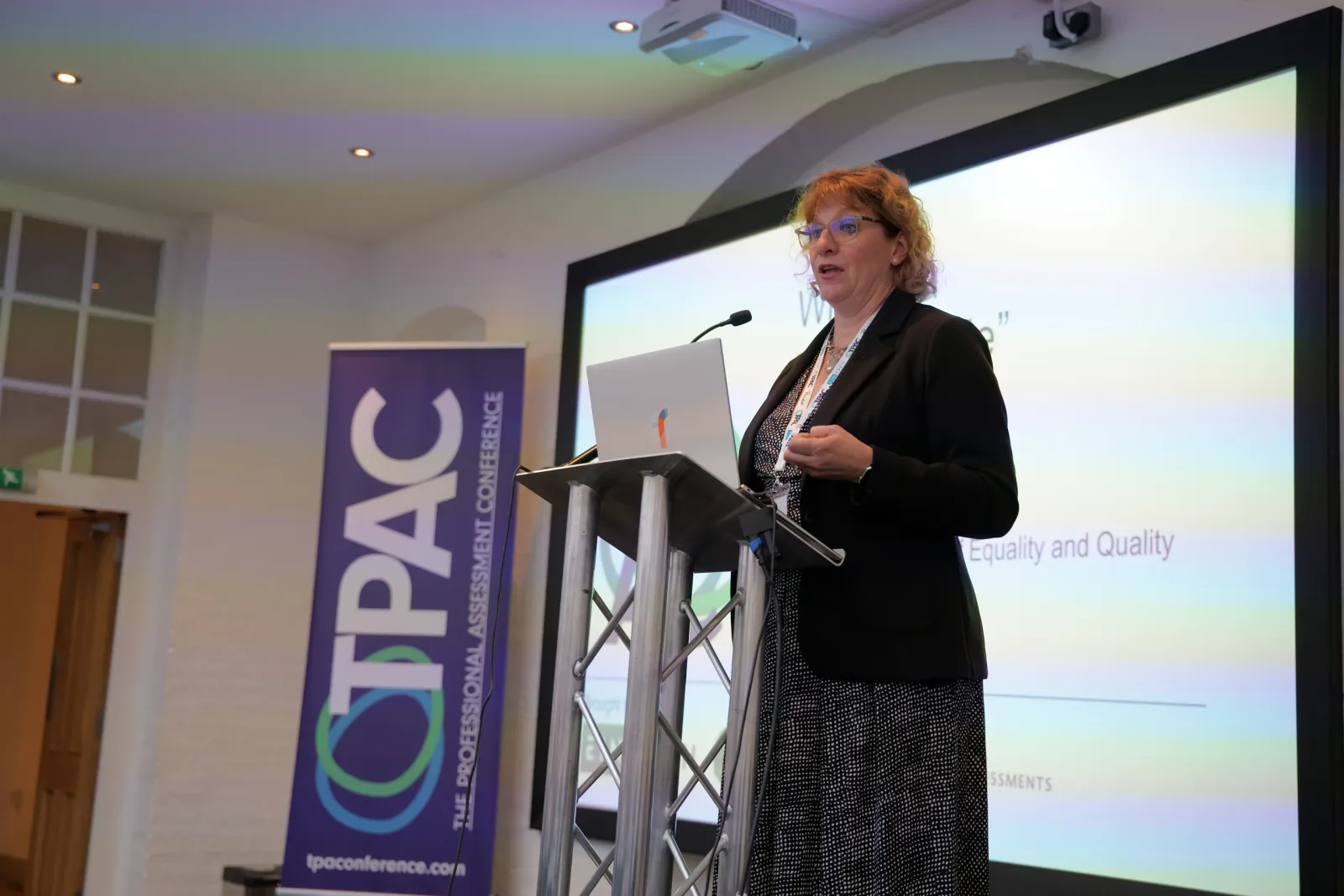
At last year’s TPAC, Jackie Panter, Head of Equality and Quality at Kaplan Assessments, tackled the question: how do you support disabled candidates in a way that is fair, lawful and workable, while still protecting the standard and integrity of the assessment? Here’s a summary of what attendees took away from her outstanding presentation.
Know your legal responsibilities
The starting point is the Equality Act 2010.
A person is disabled if they have a physical or mental impairment with a substantial and long-term impact on their day-to-day life and activities.
If a provision, criterion or practice puts a disabled person at a substantial disadvantage, adjustments must be made.
That duty goes beyond the assessment itself to include:
- How candidates apply for reasonable adjustments
- How assessments are scheduled
- The physical environment and equipment used to administer the test
- The support provided before, during and after the assessment
For many candidates, the process itself can add pressure through forms, evidence and waiting times.
Decisions about what is reasonable need to consider both the legal duty and the candidate’s experience.
Consider duty through a values lens
Legal compliance is part of the picture, but it isn’t what drives the day-to-day decisions.
The focus is fairness, and that comes back to a simple question Jackie often asks her team: if two candidates are sitting the same assessment and one has to navigate additional steps because of a disability, what can we remove so their experience feels comparable?
That way of thinking carries through the whole process, from first contact to results. The aim is to make the experience as smooth as possible by removing avoidable barriers, without lowering the bar of the assessment itself.
University of Bristol vs Abrahart
The University of Bristol vs Abrahart case centred on a student with severe social anxiety who was required to complete oral assessments in front of other students as part of her course. No adjustments were made, and ultimately this led to the student taking her own life. The court found that the university had failed in its duty.
After the judgment, the Equality and Human Rights Commission issued guidance, where two points in particular have had a wide impact beyond higher education:
- Institutions need to act where they have knowledge of a disability, even if that sits across different teams
- Relying on formal medical evidence can create further disadvantage, where it is slow or costly to obtain
Candidates now reference this directly in their requests, and it has changed expectations about what providers should be able to respond to and how quickly they should do it.
What about competence standards?
There is a clear legal position on competence standards. Given that they define what a candidate must be able to do in terms of the level of knowledge or skill being assessed, they don’t need to be adjusted.
The challenge is being precise about what that standard is. Kaplan has invested time in clearly defining this across its assessments, making it easier to respond consistently when requests for adjustments come in.
Some examples include:
- A closed-book legal assessment remains closed-book, as access to materials would change what is being tested
- Advocacy can still be assessed if the delivery method changes, so a candidate with a speech impairment may have their submission read aloud
Assessment providers need to distinguish between what is being assessed and how it is assessed, as the method can often be adapted, while the standard itself cannot.
Operational challenges of reasonable adjustments
One key challenge is timing.
For example, requests can come very close to an assessment date, whether that’s for extra time, alternative formats or a different location, and candidates may reasonably expect providers to adapt, even at short notice.
What candidates may not see is the delivery model that’s already in place: assessment centres are booked, staff are scheduled and buildings come with fixed hours and constraints around access, security and facilities. Even producing alternative formats involves design and quality assurance processes that take time.
Kaplan’s response has been to map this in detail, looking closely at every step, dependency and deadline across the process. That work serves two purposes:
- It tests whether internal constraints are genuinely reasonable
- It gives candidates a clear explanation of what sits behind a decision
It also becomes important if a decision is challenged. Being able to show what was anticipated, what was considered and why something could not be done is part of meeting the legal duty.
From “evidence” to “supporting information”
Language matters here, and the shift from “evidence” to “supporting information” is deliberate in changing the tone of the process.
Candidates are not being asked to prove themselves. They are being asked to share enough about their circumstances for adjustments to be properly considered.
At the same time, high-stakes assessments still need a level of assurance. While higher education is moving towards self-declaration in some contexts, Kaplan has taken a different position and continues to require supporting information from a qualified practitioner.
What has changed is how that information is used. Rather than working to a narrow checklist, decisions are made by looking at the full picture:
- What the practitioner says
- What the candidate describes
- Previous adjustments in education or work
- The specific demands of the assessment
Assessment providers must be aware that some cases don’t fit neatly into a standard process, particularly where information is still emerging or incomplete. For example, where a GP describes symptoms without a formal diagnosis, or a candidate may be waiting years for one. In those situations, cases are reviewed carefully, often as a team, to reach a decision that feels balanced and fair.
Fairness means consistency, not uniformity
Practitioners will sometimes recommend adjustments that don’t quite align with what a professional assessment can realistically support. Candidates may have received more generous adjustments in other settings, and those expectations can carry into future requests.
Each case is still looked at on its own facts, but when a request can’t be accepted as it stands, the response needs to be a conversation rather than a flat refusal.
Decisions may differ from case to case, but the principles behind them and the way they are explained should feel consistent. The Kaplan team will talk through how a decision has been reached, why a different adjustment may be more appropriate, and how that aligns with the need to treat candidates fairly across the cohort.
This takes time and depends on experienced assessors and regular case reviews to keep decisions aligned and properly thought through.
The range of adjustments is expanding
The range of adjustments being requested is growing, and the detail within those requests is increasing too.
They can include:
- Alternative locations, including remote or bespoke venues
- Changes to lighting, temperature or noise levels
- Flexible scheduling, including start times and rest breaks
- Tailored support at test centres, such as named contacts or pre-visits
- Specialist formats for materials, including colour, font and layout
- Assistive technology, with careful checks around data security
What sits behind each of these is coordination across multiple teams, including bookings, operations, technology and delivery partners, all working together to make adjustments possible. A lot of that work isn’t visible to candidates, but it is significant.
Technology brings new questions
Assistive technology is now part of everyday life, and candidates often expect to use the same tools in an assessment setting.
Some of those tools don’t work in a secure assessment setting, particularly where they share data externally. That isn’t always easy to explain.
Candidates may hear different advice from other sources, so it takes careful communication to set out what is possible and why certain options can’t be used, while still offering alternatives that support them.
This is also an area that is moving quickly, and providers must keep pace with technological changes while maintaining the security of their assessments.
Saying “no” rarely starts with the word itself
There is real pressure across the sector to agree to requests, particularly when the risk of getting a decision wrong feels high.
In practice, though, decisions are rarely framed as a simple yes or no. The process is more often a dialogue, built around:
- Understanding the candidate’s experience
- Explaining the context of the assessment
- Exploring alternative ways to provide support
- Escalating where needed
That doesn’t always lead to the originally requested outcome, but the aim is to reach a position that is fair, defensible and workable for everyone involved.
The direction of travel is clear
More candidates are declaring disabilities. Data from higher education shows steady growth over the past decade, and changes in how universities approach adjustments are now feeding through into professional assessments.
With that comes rising expectations and closer scrutiny. Providers are starting to respond more collectively, comparing approaches, challenging their own assumptions and learning from emerging cases.
But a changing context doesn’t change our focus. Reasonable adjustments are about removing barriers where they exist, protecting the integrity of the assessment and making decisions that you can stand behind when they’re tested.
This is an area that will continue to evolve as practice and expectations shift. We’re also seeing attitudes change towards ‘inclusive design’ when it comes to creating exams and assessments themselves. Often accommodating for ‘one’ benefits ‘many’.
Category:Awarding organisations, membership & skills

Written by
Kristina Preston
Director | Awarding, Assessment & Professional Education
With over 10 years of recruitment experience at every level across the education and skills sectors, Kristina is skilled in the appointment of roles covering the design, development, delivery and quality assurance of educational products and services in awarding organisations, AAOs and professional membership bodies. She leads the partnership with the Federation of Awarding Bodies as their Platinum Supplier of executive search, recruitment, and board development services.
Kristina enjoys the camaraderie, collaboration, innovation, determination, and passion of the sectors she supports and advocates for this niche area of the UK and worldwide education system. She recognizes the far-reaching impact of awarding and skills qualifications at all levels, raising aspirations and helping people access life-changing qualifications and training.
Outside of work, Kristina recently became a mother and enjoys family travel. After 15 years as a competitive cheerleader, she serves as a Non-Executive Director on the board of SportCheer England, working toward official sport recognition. Kristina is also learning Polish to connect with her heritage and is an avid Aston Villa fan.
Related articles

EPAO to AAO: Preparing for the apprenticeship assessment reform
Read further
Ofqual governance principles and what AO boards need to know
Read further
How good governance strengthens awarding organisations
Read further
Awarding organisation trustee interview preparation guide (with bonus cheat sheet)
Read further
Awarding Bodies: Insights from the Experts – Deborah Jenkins
Read further
Awarding Bodies: Insights from the Experts – Candace Miller
Read further
Awarding Bodies: Insights from the Experts – Phil Beach CBE
Read further
How established membership organisations adapt to change
Read further
What AAO readiness really means for leadership and governance
Read further
How to strengthen governance in awarding organisations
Read further
How cross-sector trustees strengthen awarding organisations
Read further