
Diversity in Higher Education Governing Bodies
Off the back of the Advance HE’s “Diversity of Governors in HE” report, Dr Sophie Carney suggests ways your HE institution can implement more inclusive recruitment practices for your board.
Advance HE’s “Diversity of Governors in HE” report, released in December 2024, reviews data from 209 institutions and 3970 governing body members to assess progress in diversifying governing bodies across sex, ethnicity, disability, and age. It highlights successes and areas for improvement in creating more representative governance.
The report found the higher education board membership is made up of:
- 43% women
- 15% Black, Asian or minority ethnic
- 6% with disclosed disabilities
- 41% of governors were aged between 26 and 55.
It will be interesting for institutions to benchmark their board statistics against these sector figures to establish their strengths and areas for development. However, we know this picture constantly changes as members step down and newly recruited board members take their place.
At Peridot Partners, around 50% of all our appointments across the education, charity, not for profit and health practices are non-executive board roles. We understand the challenges organisations can face when attracting the right skills and expertise while creating a board that embodies the communities they serve.
We collect anonymised equality monitoring data to ensure we can provide an accurate overview of the diversity of our candidates from application through to appointment. Across the education sector, our data from the 2023-2024 financial year shows:
- 58% of our board appointments are women
- 16% identify as Black, Asian or minority ethnic
- 9% have a disclosed disability
- 8% identify as part of the LGBTQIA+ community
What are the challenges when recruiting new governors?
Higher education institutions are competing against thousands of other organisations to secure the most relevant people for their governing bodies, and some candidates have their pick of opportunities. In our experience, qualified finance and audit professionals with expertise in strategic leadership are in great demand.
Without remuneration as an incentive, most institutions rely on engaging people through an alignment between their motivations and the institution’s mission and values, areas of personal and professional interest that align with the skills brief, and the person’s capacity to fully commit to the role.
As a data exercise, the Advance HE report doesn’t provide qualitative information about the experience of HE governors. Understanding the experience of your higher education governors is essential in understanding how well you can attract and retain talented and diverse board members and where you can make significant improvements in your recruitment and onboarding processes.
What impacts the recruitment of diverse boards?
In our collective experience, these are a few key areas that impact candidate engagement.
Your recruitment process
Are you using the same old ‘tried and tested’ routes to identify new board members? If you only reach out to your known networks, you will likely engage very similar profiles to those you already have on the board and miss the opportunity to broaden your pool of potential candidates.
Have you thought about how inclusive and accessible your recruitment process is? This comes down to the language and images you use to promote the opportunity and where you advertise the role. Why not check with your HR team to ensure your governing body’s recruitment process meets the robust standards in your HR recruitment policies? As this is not a paid position, you may only adopt some practices. Still, you expect people to commit considerable time and expertise to your institution voluntarily, and candidates deserve the same respect and equitable process you run for paid employment candidates. This will demonstrate your commitment to a fair, equitable and transparent process.
We always encourage our clients to include information about onboarding and induction processes and ongoing support and training for governors in the candidate packs. This is especially important when encouraging first-time non-executive board members and underrepresented groups to apply for the role.
How accessible are your board meetings?
We find time and time again that restrictive board and committee meeting schedules put off the types of candidates institutions are desperately trying to attract. Most HE governing bodies want to engage those with recent and relevant senior-level experience in their field of expertise or sector, which means those candidates will likely have full-time work commitments to manage alongside a board appointment. Our candidates always want to give their all to a board role, and if they feel that the board schedule will not allow for this, they won’t apply. If you’re only willing to engage those who can attend every meeting in person, you’ll exclude some great candidates who may offer something different.
Have you considered how flexible you can be as a board to accommodate these commitment challenges? For example, do you take a hybrid approach to attendance at board and committee meetings? Do you clearly set out your expectations and any flexible arrangements that can be made when advertising the opportunity?
Search strategy: general strategic leadership
Your annual skills matrix review is essential in ensuring your board has independent expertise from relevant specialisms, sectors and industries. Conversely, a high degree of focus on an overly specific skillset could impede your ability to attract a broad range of diverse talent that could add huge value to your institution and board. Why not try advertising for a more general strategic leadership skillset to open up the pool of interested candidates and sector expertise?
Recently, we supported an institution in thinking differently about its board skills brief to broaden its pool of candidates. Instead of focusing on one or two specialisms, we went out to identify strategic leaders who would bring a different view to the board, with expertise that didn’t necessarily sit neatly within the clearly defined skill bands (e.g., finance, legal, HR, etc.).
We engaged some brilliant candidates who brought diversity in every way and would be able to contribute to the broader board agenda. Candidates had a real passion for the city and region and the university’s values from various sectors, including private and public health, pharmaceutical, central government, manufacturing, technology, charity, and skills innovation.
Have you considered co-opted members?
You could also consider co-opting members who would then join the board as full members. This offers a valuable pathway to train first-time non-executives, support succession planning, and diversify boards and committees while securing a firm commitment that lasts as long as your terms of office allow.
This approach provides aspiring, diverse talent with accessible opportunities, often requiring just 4-5 meetings per year with flexible attendance.
In our experience, one such appointment led to a full governing council position and the co-opted member went on to become the vice chair of the committee they originally joined. Their progression in the governing body mirrors that of their executive leadership career, and the institution benefits from their developing executive experience in their field.
Inclusive recruitment campaigns
We develop genuine partnerships with our clients to create a long-term relationship and appoint multiple board and committee roles over several years. Celebrating successful board appointments is an essential factor in inclusive recruitment campaigns.
In one campaign, we asked recently recruited governing body members about their experience joining the institution’s board and used this to promote our next recruitment campaign. First-time governors and neurodiverse people reflected that their contributions were strongly valued. This showed the University’s commitment to diversity and inclusion, leading to more appointments that further diversified the board.
You can read more about our approach towards HE board recruitment through several case studies and our track record of appointments by visiting /specialisms/higher-education-recruitment
If you’d like to discuss how Peridot Partners could help you diversify your institution’s governing body, then please get in touch.
Category:Diversity and inclusion

Written by
Dr Sophie Carney
Principal Consultant | Higher Education
Dr Sophie Carney is passionate about higher education, with 16 years of experience on every side of the table – as student, researcher, lecturer, and student services manager.
Having spent over ten years working in higher education as an academic and in student support services, Dr Sophie Carney was keen to continue her career by supporting the sector to recruit transformative leaders.
As the Principal Consultant for Higher Education Appointments in Peridot's Education Practice, Sophie leads on the appointment of executive, academic and professional services leaders across the higher education sector. Sophie also leads on the recruitment of outstanding talent to the governing councils, boards and committees of higher education providers, universities and other sector bodies, with a track record of appointing chairs, vice chairs, independent members, non-executive directors and committee members.
Higher education has provided Sophie with many opportunities for personal and professional development. She enjoys working with clients and candidates who are equally driven by their passion for the opportunities and transformative impact of higher education on the lives of thousands of students.
When she's not at work, you will most likely find Sophie walking her cockapoo, Bella, along the River Trent, browsing around the antique shops of Newark, or wading through a pile of historical fiction novels and art history tomes.
Approachable, insightful, and passionate about education, Sophie brings a wealth of experience and a personal touch to each appointment she leads. Her deep understanding of the sector and commitment to supporting educational leadership make her a trusted advisor and consultant to transform leadership and inspire change across the higher education sector.
Related articles

Women in Leadership: Wendy Sutherland
Read further
Women in Leadership: Rachel Nicholls
Read further
Natspec: our new corporate membership supports the voice of specialist further education
Read further
Anti-racist and diverse recruitment practices in the further education sector
Read further
How can renewing trustees and seeking trustee diversity help your charity’s long-term success?
Read further
Governance Culture: Navigating policy, politics and people
Read further
What makes an effective MAT trustee?
Read further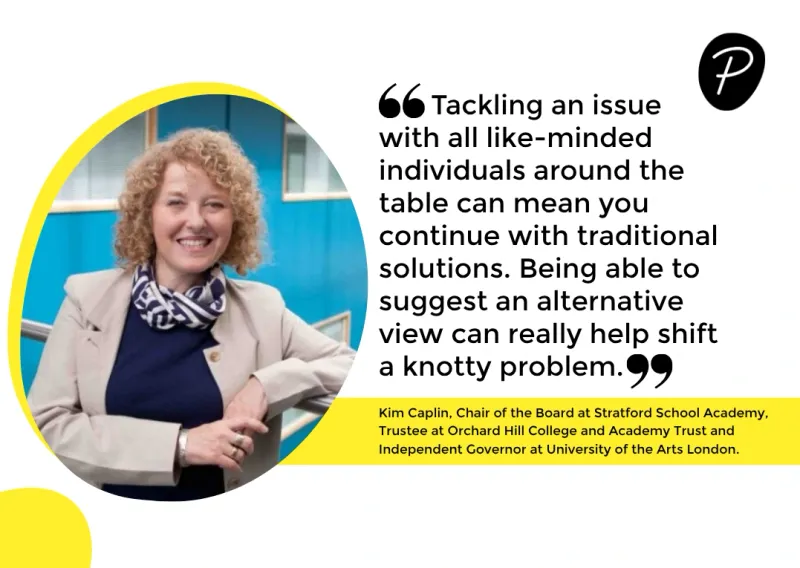
Why cross-sector board appointments strengthen governance: Insights from Kim Caplin’s journey
Read further
Become a college governor to launch your non-executive career.
Read further
Five skills you need to become an FE College Governor
Read further
I’m thinking about becoming a Further Education Governor – what do I need to know?
Read further