How museums are rethinking collections through decolonisation
Explore how the Powell-Cotton Museum is rethinking collection interpretation through community collaboration and long-term commitment.
Museums and heritage organisations are increasingly asking difficult questions about how collections are interpreted, whose perspectives are represented and how historical context is communicated.
At the recent Museums + Heritage Show, Madylene Beardmore shared the Powell-Cotton Museum‘s approach to this work and what it takes to move from one-off projects towards something more embedded and long-term.
Rethinking a collection’s history
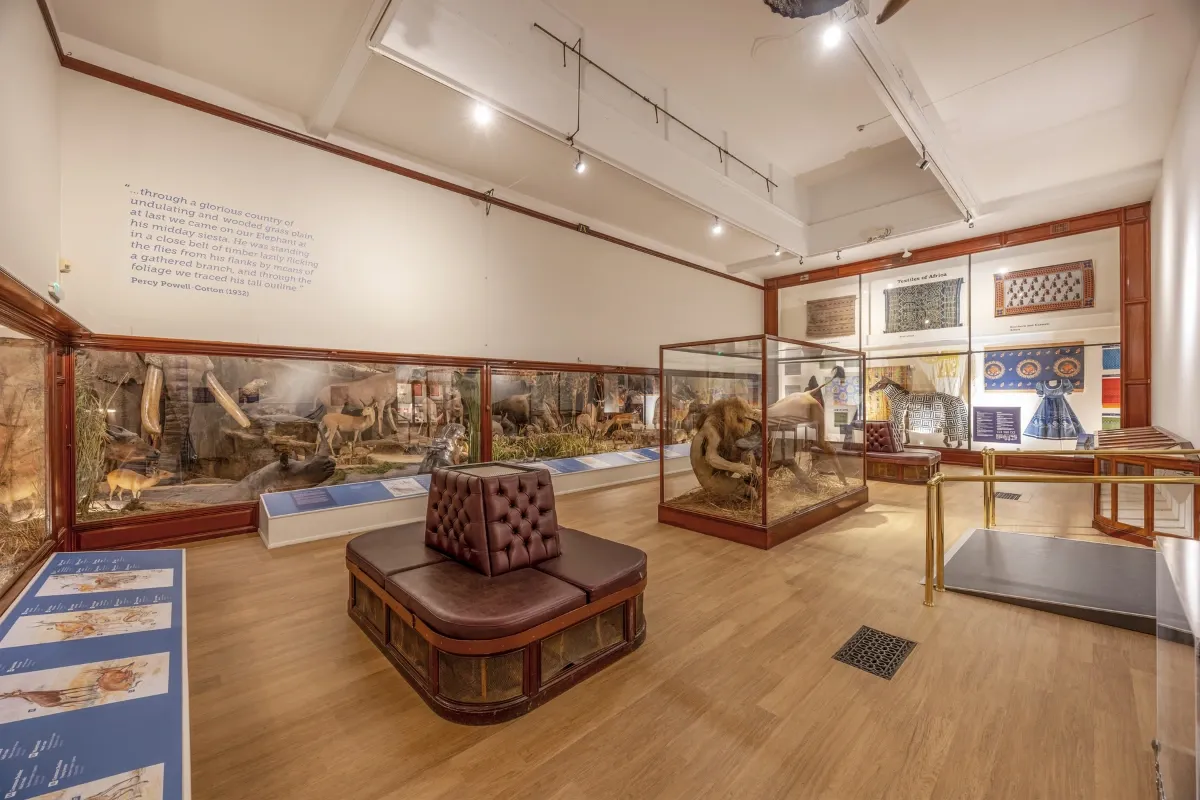
The Powell-Cotton Museum presents an interesting challenge because of the collection’s history. Percy Powell-Cotton gathered objects throughout his travels, many of which were acquired during a period shaped by colonial systems and significant power imbalances.
Earlier interpretations of the collection reflected many of those attitudes. Objects were often treated as ‘curios’, with limited context around where they came from, who created them or the significance they held. They were often stuffed into small cabinets, either mislabelled or unlabelled and arranged in a way that showed little respect for their origins and the cultural context they came from. Likewise, the museum formerly displayed a number of animal skulls on its walls, lending it the feel of a colonial trophy room rather than a museum.
Reinterpreting these collections meant looking again at how objects were presented, whose perspectives informed the interpretation and how visitors understood the stories being told.
Bringing communities into the conversation
To help contextualise the collections and rethink how they were interpreted, the museum convened a Community Advisory Group comprising people of African descent, many with family connections to the regions Powell-Cotton travelled.
Working alongside museum staff, the group co-curated the redisplay of East African material from South Sudan, Kenya and Uganda, which reopened in 2025. They engaged with the objects, their histories and how they had been used, helping to present them with more context and a stronger connection to the cultures they came from.
A photography exhibition developed as part of the project also helped recontextualise some of the items through a distinctly British lens. One example placed objects within the setting of an afternoon tea, helping visitors draw connections between customs that may previously have felt unfamiliar and experiences within British culture. It encouraged people to see points of connection with cultures that had historically been presented as ‘other’.
The next phase of the project, which is already underway, focuses on the museum’s Zulu collections from Southern Africa.
Decolonisation as an ongoing commitment
Madylene spoke about decolonisation as something that shouldn’t sit separately as a standalone project with its own funding stream and endpoint. It was presented as an ongoing part of how the museum thinks about its collections and the stories it tells.
That commitment is also evident in how the work continued beyond the redisplay itself, and a member of the Community Advisory Group was also invited to join the board as a Trustee, helping to ensure those perspectives remained part of future discussions and decisions.
How this connects to a museum’s future
Work like this can easily slip down the priority list because it sits outside the day-to-day pressures of running a museum. Yet the impact of this work reaches far beyond the collections themselves.
Projects that help people see themselves reflected in collections, understand different perspectives or build stronger connections with museums can influence who visits, how communities engage and how staff feel about the organisation they work for.
It also raises important questions about funding. If this work becomes part of how a museum develops and evolves, it needs long-term support rather than one-off funding attached to a specific project. Fundraisers have an important role in helping organisations think more broadly about where that support comes from and how it contributes to the museum’s future direction.
Museums that continue to evolve how collections are understood and presented may also find that new opportunities emerge in fundraising and support. As organisations build stronger relationships and reach wider audiences, conversations with funders can evolve too. Those conversations are likely to feel more meaningful when they grow naturally from the work itself rather than becoming the reason for doing it.
Category:Arts, Heritage & Culture

Written by
Josh Larkin
Senior Consultant | Charities
Josh Larkin is passionate about the arts, culture and heritage, and is a strong advocate for the vital role fundraising plays in sustaining the sector. His love of culture began with childhood trips to museums, galleries and orchestras, a passion that continued into adulthood and has helped shape his professional path.
After completing a degree in English Literature and Philosophy, Josh worked across the fundraising sector for a range of charities in the UK and Australia, gaining broad experience across multiple income streams. While his core focus was individual giving, the reality of working in small teams meant contributing to legacies, corporates, major donors, and trusts and statutory fundraising. This gave him a holistic understanding of what effective fundraising looks like.
Values-led and deeply committed to the sector, Josh moved into recruitment to support a wider range of cultural and charitable organisations. He now uses his insight and first-hand experience to help arts and heritage organisations find exceptional fundraisers in an increasingly competitive market, while supporting both organisations and candidates to navigate many of the challenges he once faced himself.
Alongside his work in arts and heritage, Josh also recruits for roles across the broader charity sector, with a particular focus on homelessness and social welfare. His remit extends beyond fundraising too, and he regularly supports searches across marketing and communications, brand, PR, membership, advocacy and policy.
Beyond his professional dedication, Josh is a lover of cinema, Queens Park Rangers FC (an often challenging relationship) and Bob Mortimer.
Related articles

David Hingley appointed as Head of Arts, Heritage and Culture at Peridot Partners
Read further
Chairs in Conversation: Chris Loughran, Chair at Beamish
Read further
Inclusive governance within the arts, heritage and culture sectors
Read further
How leadership influences psychological safety
Read further
Leadership under pressure: creating the conditions for joy
Read further
Building an authentic employer brand for skills providers
Read further
How to hire for culture add, not just culture fit
Read further
Foster Care Fortnight 2025: The Power of Relationships
Read further
Five reasons to show the salary in job adverts
Read further
Using the DRAMMA model for improved mental health and well-being
Read further
How inclusion drives Hopwood Hall College
Read further