
Confronting a crisis: smartphones, mental health and the new battle for attendance
Persistent absence is rising. Explore how strong school leadership tackles the impact of smartphones, mental health and Covid on attendance.
Attendance buddies, queue-jump passes, hot chocolate and doughnuts, movie-night rewards, home visits, late starts, morning respite, reduced timetables… These are just a handful of the attendance initiatives and incentives schools are rolling out. Anyone who has spent time in or around schools can probably think of dozens more.
These efforts show how far schools will go to bring pupils through the door. But, attendance statistics across schools in the UK are shocking – in the Autumn term of 2024-25, 17.79% of pupils were persistently absent, which means missing 10% or more of school sessions. This equates to 19 days of lost learning.
Attendance, disadvantage and SEND
The headline figures hide the real story of post-COVID attendance. Absence varies sharply by phase: 5.2% in primary, 8.6% in secondary and 12.9% in special schools.
Look closer, and the picture is starker still. Pupils eligible for free school meals miss lessons at nearly twice the rate of their peers (10.6% vs 5.4%). Those with an Education, Health and Care Plan (EHCP) are absent more than twice as often as pupils with no special educational needs or disabilities (SEND) (13.7% vs 6%).
Schools can only support pupils when they are present, no matter what policies and procedures are in place. To put it bluntly, the most vulnerable students – those most in need of the social, emotional and academic benefits of a good education – are the ones who are missing out.
The effect of this lost learning is tangible. The Education Policy Institute reports the disadvantage gap is now at its widest since 2011. Disadvantaged pupils finish secondary school an average of 19 months behind their peers. For students with SEND, the picture is bleaker still: the Education Endowment Foundation finds that their attainment gap is one and a half times greater than the disadvantage gap.
The more school that students miss, the less progress they make, and it is no coincidence that the attainment gap is growing as the attendance crisis deepens. The challenge that schools are facing nationally is how to get the pupils that they most need to reach through the door.
The impact of COVID
You can’t talk about school attendance without looking back at the pandemic. During two national lockdowns, UK schools closed to most pupils for around eight months in total. According to the Centre for Social Justice, persistent absence is now 78% higher than before Covid, and severe absence—attendance below 50%—has risen by 187%.
The picture is complex, and no one has all the answers. What’s clear is that absence rates have climbed, the mental health crisis has deepened, and the most vulnerable students have been the worst affected.
Mental health and mobile phones
It’s hard enough to untangle the knotty links between attendance, the pandemic and young people’s mental health. Add one more complicating factor: mobile phones.
Their presence and the pull of social media is felt not just in schools but in almost every corner of our and our children’s lives. Only recently have we started to question that impact seriously.
Published in 2024, Jonathan Haidt’s The Anxious Generation explores the connection between the rising mental health crisis and the spread of smartphones and social media since the early 2010s. He argues these devices affect young people’s development through a mix of reduced face-to-face contact, sleep loss, fractured attention and addiction.
Schools and society are now dealing with the aftermath of long months when young people had little face-to-face contact beyond their immediate families. Locked down at home, many turned to their phones as their main source of entertainment and social life.
Studies show that screen time rose across all age groups during the pandemic, with the sharpest increase among primary pupils—many of whom are now in secondary school.
We’ve spoken to school leaders about pastoral issues such as group chat conflicts that spilt into physical fights, or students breaking down in tears after online bullying. In some cases, it led to significant loss of learning through exclusion, skipped lessons or, at the worst, a complete rejection of school.
Stories like these are now common. Teachers and school leaders see every day how screens and social media shape mental health and attendance, and they are working hard to respond.
Smartphone bans – a potential solution?
In September 2025, Barnet became the first London borough to ban smartphones in school for all new Year 7 students until they reach Year 11. In Southwark, 17 of 20 secondary schools have made a similar pledge.
This cultural shift has been fuelled in part by the charity Smartphone Free Childhood, which raises awareness of the risks and encourages parents to delay giving their children a smartphone. So far, more than 150,000 parents have signed its pact, promising to wait until their child is at least 14. The impact of these initiatives is still to be seen, but with growing evidence linking smartphone use to poor mental health, stricter phone policies may help protect students and support them to attend school feeling safe and ready to learn.
However, this solution is by no means a quick or easy fix. Smartphones are so woven into daily life that many parents worry about their children travelling without them; maps and location tracking give real peace of mind.
Working in a school where phones were allowed but confiscated if seen or heard, I’ve often heard stories of parents getting upset when their child’s phone was taken. That school now uses a ‘simplephone’ policy: pupils can carry a basic handset without internet access, which is returned the same day if confiscated. A smartphone, by contrast, is kept for at least a week. Policies like this aim to balance the need for connection with the need to shield young people from the pull of social media and other addictive apps.
Leading through the school attendance crisis
Attendance is now more than an operational concern—it’s a measure of how well schools can support pupils through deep social change. Mental health pressures, inequality and the lasting effects of Covid are all part of the picture.
To meet this, schools are having to find new ways to help every young person through the door. There’s no single fix. What matters is constant adaptation, learning and sharing what works.
How is your organisation rising to the challenge, and what lessons are emerging from your context?
Category:Education

Written by
Eddie Caviezel Cox
Head of Schools, Academies & Education Charities
At Peridot, Eddie leads a dedicated team focused on recruiting top talent for schools and academy trusts. His commitment to social impact is central to his work, ensuring leaders placed make tangible community differences.
Eddie's career began in graduate and early talent recruitment, managing large-scale corporate and Civil Service processes. Diversity and inclusion expertise has remained constant throughout his career, ensuring leadership appointments reflect diverse communities served. After transitioning to executive search, he found his true calling.
Before joining Peridot in 2022, Eddie worked as Recruitment Manager for the Association of Colleges, successfully bringing senior leaders into further education from outside the sector. Since joining Peridot, he has placed senior leaders and non-executive directors across educational organisations, working with UK providers including Oasis Community Learning and Dixons Academies.
Before relocating to London in 2023, Eddie served on a local governing body at a primary school in Royal Leamington Spa. Eddie is a retired non-league footballer, now spending weekends running ultra marathons, volunteering, and following Britpop bands. He serves as Trustee at a charity providing educational resources to underprivileged African communities.
Related articles

From schools to MATs: is your board ready? Part two
Read further
From schools to MATs: is your board ready? Part one
Read further
The Great Leveller – Education as a Means to Social Mobility
Read further
Apprenticeship pathways: stories of success – Helen James OBE
Read further
Searching for talent in a competitive higher education market
Read further
Tackling the education sector’s obsession with size: does it really matter?
Read further
What does recruitment with integrity really look like in a Multi Academy Trust?
Read further
What makes an effective MAT trustee?
Read further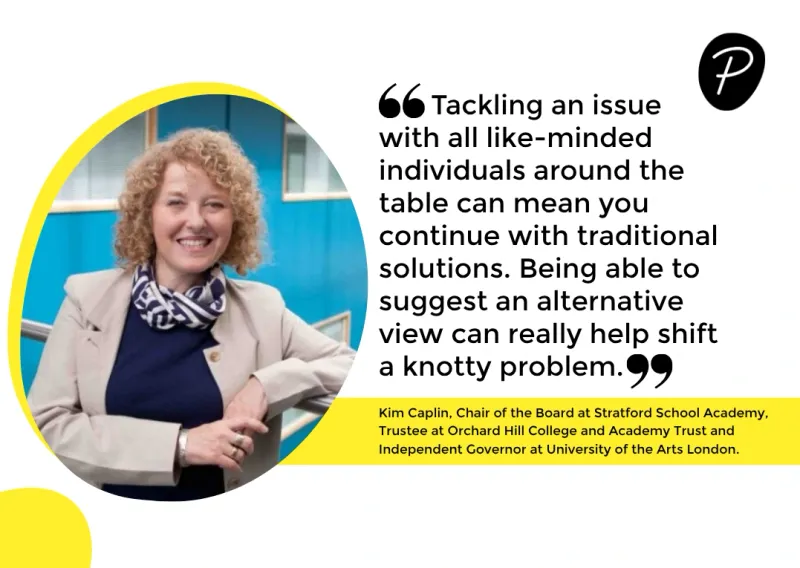
Why cross-sector board appointments strengthen governance: Insights from Kim Caplin’s journey
Read further
Navigating recruitment processes for academy trust leaders
Read further
Labour’s Educational Vision: Preparing MAT boards for change, part 2
Read further